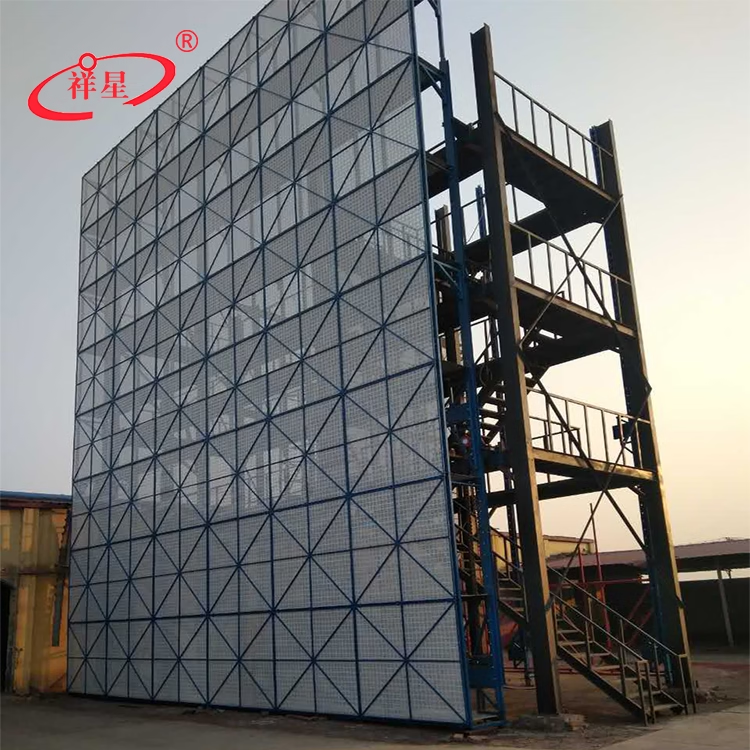
Hengxiang Self-climbing scaffolding system also known as attached lifting scaffold, is suitable for high-rise buildings and super high-rise shear wall structures. It is used for high rise building facade protection. The self climbing formwork variants for facades, building cores, shaft structures as well as inclined bridge pylons make the construction of high concrete structures extremely fast, cost-effective and safe.
Safety is the primary principle in the design of climbing scaffolding. Fall arrestors are crucial components for ensuring the safety of the scaffolding, typically including fall arresters and limit locks. These devices activate rapidly in the event of abnormal slippage, securing the scaffolding to the attached support devices and preventing falls.
Furthermore, the safety protection system includes safety nets, toe boards, and safety gates, providing comprehensive protection for construction workers.
climbing scaffold installation
Core Structure
It mainly consists of a frame (main structure), attachment supports (wall supports), lifting equipment (such as electric hoists), safety and control devices (anti-fall, anti-tilt, and synchronous control), and protective netting, forming an enclosed operating space.
It requires only one-time installation and lifting. The climbing scaffolding system comprising wall formwork and platforms are moved from floor to floor by means of integrated hydraulic systems.
How does the self-climbing scaffolding work?
Its working principle can be summarized as follows:
The scaffolding structure is connected and fixed to the external structure of the building via support brackets and guide rails. Driven by electric hoists or hydraulic lifting devices, the entire scaffolding frame can be vertically raised and lowered along the building facade according to the construction progress.
During the raising and lowering process, the scaffolding maintains stability thanks to a set of anti-tilt and anti-fall safety mechanisms. Upon reaching the target floor, the scaffolding is reliably fixed back to the building structure, providing a safe working platform for formwork, rebar, concrete pouring, and exterior wall construction.
In short, it eliminates the need for full-height erection from the ground, allowing for continuous raising and lowering as the building is constructed, greatly improving safety and construction efficiency.
Specifications
Advantages
Material and cost saving It does not need to be erected to the full building height. Only one set of scaffold is used for the whole construction process, which greatly reduces steel pipe, fitting and labor consumption.
High construction efficiency It can be lifted and lowered automatically by an electric or hydraulic system. It moves up with the construction progress quickly, reducing the erection and dismantling time.
Improved safety performance It is equipped with anti-tilt, anti-fall, and synchronous control systems. The whole frame is stable and reliable, providing a safe and closed operating platform.
Smaller space occupation The system is attached to the building structure, with lightweight and small occupation on the construction site, which is beneficial to on-site layout and transportation.
Environmentally friendly and aesthetic It reduces material stacking and construction waste, and the integrated protective screen improves appearance and reduces dust and noise pollution.
Wide applicability It is suitable for various high-rise residential buildings, office buildings, bridges and other structures, and adaptable to different building facades.
The efficient sequence of operations facilitate a very high level of productivity. Its built-in safety screen design can effectively prevent workers and objects falling when working at a height. Hengxiang climbing scaffolding system is manufactured with advanced production process and strict inspection standards. For products price and specifications, send your inquiry any time.